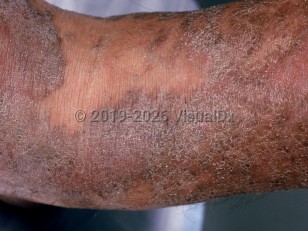
Kaposi sarcoma (KS) is a malignant neoplasm of lymphatic endothelial cell origin that occurs in several forms, including AIDS/HIV-associated KS, classic KS, African endemic KS, and iatrogenic KS. This summary discusses non-HIV-associated KS.
All types of KS are due to or influenced by human herpesvirus type 8 (HHV-8). Spindle cells of endothelial origin are the predominant cells affected. In the latent phase, HHV-8 antigens promote cell proliferation by inactivating the RB gene, which leads to transcription of S-phase genes and blocks apoptosis via p53 and p27Kip1 suppression. In the lytic phase, when tumor formation is noted, thousands of virion particles are assembled, resulting in cell lysis. HHV-8 requires additional cofactors for the development of KS. HIV coinfection acts as a stimulant for HHV-8 viral lytic expression and via its suppression of the immune system.
Classic KS is seen almost exclusively in people of Mediterranean and Ashkenazi Jewish descent, with the age of onset typically between 50 and 70 years. The disease is slightly more common in men than women (ratio of 1-3:1). This type of KS most commonly runs an indolent course for several years, with slow enlargement of macules into plaques, nodules, or tumors and the gradual development of additional lesions. Lesions are most commonly on the legs. Some early lesions can regress, and others can progress, leading to clinical appearance of lesions in multiple stages. Up to one-third of the patients with classic KS develop a second primary malignancy, most frequently non-Hodgkin lymphoma.
African endemic KS largely affects males in equatorial Africa, with an incidence in endemic areas of 1%-10%. This represents significant disease burden in equatorial Africa, as 9% of all cancers in the area are endemic KS. There are 4 variants: nodular, florid, infiltrative, and lymphadenopathic. The florid and infiltrative types are aggressive. The lymphadenopathic type mostly affects children (with equal impact to boys and girls) and is fatal.
Iatrogenic KS results from long-term systemic immunosuppression from medications such as prednisone, cyclosporine, and calcineurin inhibitors. Incidence of KS in the posttransplant population is approximately 0.5%-5%, depending on geographic HHV-8 prevalence, and rates are lower in Western nations. Patients with organ transplant involving the lung, liver, heart, or kidney are at increased risk. Visceral involvement is more common posttransplant in non-HIV KS compared with HIV-associated KS. Lesions may resolve when immunosuppressive medications are discontinued.
Lesions in all forms of KS may progress to involve or be present in other organs such as the lymph nodes, lungs, gastrointestinal (GI) tract, liver, and spleen, but HIV-associated disease is more likely to have systemic involvement. This is more likely to occur in advanced stages of the disease and more aggressive disease variants. Most visceral cases are asymptomatic, but GI bleeding can occur.
Related topic: skin cancer in organ transplant recipients
Non-AIDS-associated Kaposi sarcoma
Alerts and Notices
Important News & Links
Synopsis

Codes
ICD10CM:
C46.0 – Kaposi's sarcoma of skin
SNOMEDCT:
703625002 – Kaposi sarcoma not associated with acquired immunodeficiency syndrome
C46.0 – Kaposi's sarcoma of skin
SNOMEDCT:
703625002 – Kaposi sarcoma not associated with acquired immunodeficiency syndrome
Look For
Subscription Required
Diagnostic Pearls
Subscription Required
Differential Diagnosis & Pitfalls

To perform a comparison, select diagnoses from the classic differential
Subscription Required
Best Tests
Subscription Required
Management Pearls
Subscription Required
Therapy
Subscription Required
Drug Reaction Data
Subscription Required
References
Subscription Required
Last Reviewed:08/10/2026
Last Updated:08/10/2026
Last Updated:08/10/2026
Non-AIDS-associated Kaposi sarcoma