Contents

SynopsisCodesLook ForDiagnostic PearlsDifferential Diagnosis & PitfallsBest TestsManagement PearlsTherapyReferences

Information for Patients

View all Images (49)

Emergency: requires immediate attention
Kawasaki disease in Infant/Neonate
See also in: External and Internal Eye,Anogenital,Oral Mucosal Lesion
Other Resources UpToDate PubMed Dermatology Online Journal
Emergency: requires immediate attention

Kawasaki disease in Infant/Neonate

See also in: External and Internal Eye,Anogenital,Oral Mucosal Lesion
Contributors: Tyler Werbel MD, Susan Burgin MD

Synopsis

Kawasaki disease (KD), or mucocutaneous lymph node syndrome, is an idiopathic, multisystem vasculitis characterized by fever and mucocutaneous inflammation. It has a peak incidence in infants aged 9-11 months and is extremely rare in infants younger than 3 months of age. Most cases occur in individuals who live in East Asia or are of Asian ancestry. Although usually self-limited, potentially life-threatening coronary artery aneurysms may develop in 20%-25% of children without treatment (versus less than 5% with appropriate therapy). Mortality most often occurs within the first weeks to a year after KD due to ischemic heart disease caused by myointimal proliferation within persistent aneurysms. Infants younger than 6 months of age may be at increased risk for aneurysms.

The classic case definition of KD is fever lasting at least 5 days plus the presence of at least 4 of the following principal clinical criteria:
  • Bilateral bulbar conjunctival injection without exudate
  • Oral mucosa changes: cracked lips, "strawberry tongue," or diffuse erythema of the mucosae
  • Changes in the extremities: erythema, induration, or periungual peeling
  • Exanthem
  • Cervical lymphadenopathy (greater than 1.5 cm diameter)
A multisystem inflammatory syndrome potentially linked to COVID-19 has been reported in children and young adults; clinical features include Kawasaki-like and toxic shock syndrome-like presentations.

Codes

ICD10CM:
M30.3 – Mucocutaneous lymph node syndrome [Kawasaki]

SNOMEDCT:
75053002 – Kawasaki disease

Look For

Subscription Required

Diagnostic Pearls

Subscription Required

Differential Diagnosis & Pitfalls

To perform a comparison, select diagnoses from the classic differential

Subscription Required

Best Tests

Subscription Required

Management Pearls

Subscription Required

Therapy

Subscription Required

References

Subscription Required

Last Reviewed:08/08/2018
Last Updated:01/18/2022
Copyright © 2026 VisualDx®. All rights reserved.
Emergency: requires immediate attention
Patient Information for Kawasaki disease in Infant/Neonate
Print E-Mail Images (49)
Premium Feature
VisualDx Patient Handouts
Available in the Elite package
  • Improve treatment compliance
  • Reduce after-hours questions
  • Increase patient engagement and satisfaction
  • Written in clear, easy-to-understand language. No confusing jargon.
  • Available in English and Spanish
  • Print out or email directly to your patient
Copyright © 2026 VisualDx®. All rights reserved.
Emergency: requires immediate attention
Kawasaki disease in Infant/Neonate
See also in: External and Internal Eye,Anogenital,Oral Mucosal Lesion
A medical illustration showing key findings of Kawasaki disease : Abdominal pain, Cervical lymphadenopathy, Diarrhea, Fever, Vomiting, Rash, Hand edema, Heart murmur, Irritability, Conjunctival injection, Strawberry tongue
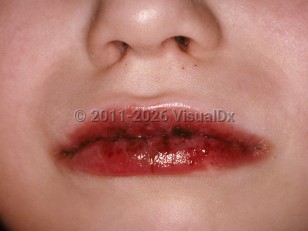
Clinical image of Kawasaki disease - imageId=266240. Click to open in gallery.  caption: 'Erosions and hemorrhagic crusting on the lips.'
Erosions and hemorrhagic crusting on the lips.
Copyright © 2026 VisualDx®. All rights reserved.