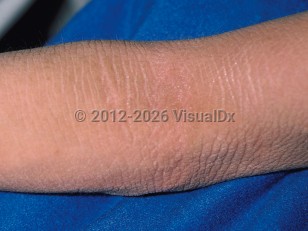
Bullous congenital ichthyosiform erythroderma, also known as epidermolytic ichthyosis and bullous ichthyosiform erythroderma (and, in the newly proposed naming convention of nonsyndromic epidermal differentiation disorders [nEDD], KRT1- and KRT10-nEDD-epidermolytic), is a rare congenital disorder presenting with blistering at birth and hyperkeratosis later in life. It presents in the neonatal period with erythema, blistering, and widespread areas of denuded skin. Some neonates may also have subtle hyperkeratosis, which may help to clinically distinguish it from other blistering disorders in neonates. After the neonatal period, infants have more verrucous scaling, particularly in the intertriginous areas. Blistering abates with time in many patients.
It is inherited in an autosomal dominant pattern, with a high (50%) frequency of spontaneous mutations. The defects are point mutations in KRT1 and KRT10, which code for either keratin 1 (K1) or keratin 10 (K10).
Ichthyosis hystrix is a variant of the disorder with very long "porcupine-like" spines composed of columns of stratum corneum with K1 or K10 mutations. Ichthyosis bullosa of Siemens is a variant with scaling and very superficial erosions related to genetic defects of keratin 2e, a keratin confined to the more superficial epidermal layers.
Rare patients with autosomal dominant ichthyosiform erythroderma with K1 or K10 mutations have small confetti-like macules (ichthyosis en confetti) that may increase in number with age. Frameshift mutations in the affected keratin gene are responsible for the new lesions.
Bullous congenital ichthyosiform erythroderma in Adult
Alerts and Notices
Important News & Links
Synopsis

Codes
ICD10CM:
Q80.3 – Congenital bullous ichthyosiform erythroderma
SNOMEDCT:
254167000 – Bullous ichthyosiform erythroderma
Q80.3 – Congenital bullous ichthyosiform erythroderma
SNOMEDCT:
254167000 – Bullous ichthyosiform erythroderma
Look For
Subscription Required
Diagnostic Pearls
Subscription Required
Differential Diagnosis & Pitfalls

To perform a comparison, select diagnoses from the classic differential
Subscription Required
Best Tests
Subscription Required
Management Pearls
Subscription Required
Therapy
Subscription Required
References
Subscription Required
Last Reviewed:04/20/2026
Last Updated:05/10/2026
Last Updated:05/10/2026
Bullous congenital ichthyosiform erythroderma in Adult