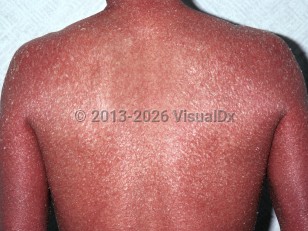
Nonbullous congenital ichthyosiform erythroderma (nonbullous CIE) refers to the clinical phenotype of diffuse scaling and erythema that develops from a range of autosomal recessively inherited gene mutations. Nonbullous CIE frequently presents at birth with a collodion membrane that, over a span of days to weeks, evolves to erythroderma and scaling with small white scales. Overlapping clinical features of lamellar ichthyosis may be present. Hypohidrosis and heat intolerance may occur. The palms and soles have varying degrees of involvement, and ectropion and scarring alopecia are rarely seen. The condition persists throughout life, but some forms lessen in severity with time.
Nonbullous CIE occurs in all sexes and races / ethnicities. It may be caused by mutations in ALOXE3, ALOX12B, NIPAL4, CYP4F22, CERS3, or PNPLA1, SDR9C7, and ABCA12.
In the newer classification of epidermal differentiation disorders, conditions are named after the causative gene. Therefore, nonbullous CIE is considered a number of separate entities, for example, ALOXE3-nEDD (ALOXE3 nonsyndrome epidermal differentiation disorder).
Complications include growth delay in those with severe erythroderma, and rarely, adults with this disorder have developed cutaneous squamous cell carcinomas.
Nonbullous congenital ichthyosiform erythroderma in Adult
Alerts and Notices
Important News & Links
Synopsis

Codes
ICD10CM:
Q80.8 – Other congenital ichthyosis
SNOMEDCT:
267372009 – Congenital non bullous ichthyosiform erythroderma
Q80.8 – Other congenital ichthyosis
SNOMEDCT:
267372009 – Congenital non bullous ichthyosiform erythroderma
Look For
Subscription Required
Diagnostic Pearls
Subscription Required
Differential Diagnosis & Pitfalls

To perform a comparison, select diagnoses from the classic differential
Subscription Required
Best Tests
Subscription Required
Management Pearls
Subscription Required
Therapy
Subscription Required
References
Subscription Required
Last Reviewed:04/30/2026
Last Updated:04/30/2026
Last Updated:04/30/2026
Nonbullous congenital ichthyosiform erythroderma in Adult