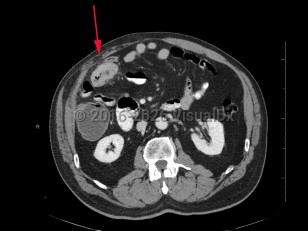
Colon cancer is a malignancy, often adenocarcinoma, arising between the cecum and rectum. Presentation can be variable. Some tumors are detected on routine screening colonoscopy in asymptomatic patients. In other cases, patients present with bowel obstructions due to tumor growth. Patients often have an iron deficiency anemia, which may or may not be symptomatic. They may also report thin-caliber stool or hematochezia, depending on the tumor's location, size, and degree of mucosal invasion.
Colorectal cancer is the second leading cause of cancer death in the United States when men and women are considered together. Advanced age, male sex, smoking, a family history of colon cancer, and inflammatory bowel disease (especially ulcerative colitis) are the strongest risk factors for developing colon cancer. Overall, the incidence of colon cancer in older patients, particularly those aged 65 years and older, is declining, likely due to a combination of screening and changes in risk factors (eg, decreased smoking). But for patients aged younger than 55 years, the incidence of colon cancer has been rising. In younger patients, hereditary factors such as polyposis coli, MUTYH-associated polyposis, and hereditary nonpolyposis colorectal cancer (HNPCC), or Lynch syndrome, also increase the risk of colon cancer development. In many instances, this risk can be modified by screening or surveillance colonoscopy, as most colon cancers arise from adenomatous polyps, which can be fully resected. Lynch syndrome is associated with 3% of all new cases of colon cancer.
The most common sites of metastasis of colon adenocarcinoma are the liver and lungs as well as the peritoneum and distant lymph nodes; rarely, metastatic oral lesions occur. Cutaneous metastases of colon adenocarcinoma most commonly occur on the abdominal skin and may occur in the area of abdominal surgical scars.
Prognosis is related to cancer staging (tumor depth, lymph node involvement, metastatic spread) at time of diagnosis. Treatment often includes a combination of surgical resection and chemotherapy.
Approximately 10% of metastatic colon cancer patients have the BRAF V600E mutation, which is associated with a poor prognosis.
Related topic: rectal carcinoma
Colon cancer
Alerts and Notices
Important News & Links
Synopsis

Codes
ICD10CM:
C18.9 – Malignant neoplasm of colon, unspecified
SNOMEDCT:
363406005 – Malignant tumor of colon
C18.9 – Malignant neoplasm of colon, unspecified
SNOMEDCT:
363406005 – Malignant tumor of colon
Look For
Subscription Required
Diagnostic Pearls
Subscription Required
Differential Diagnosis & Pitfalls

To perform a comparison, select diagnoses from the classic differential
Subscription Required
Best Tests
Subscription Required
Management Pearls
Subscription Required
Therapy
Subscription Required
Drug Reaction Data
Subscription Required
References
Subscription Required
Last Reviewed:06/08/2026
Last Updated:06/08/2026
Last Updated:06/08/2026
Colon cancer