Contents

SynopsisCodesLook ForDiagnostic PearlsDifferential Diagnosis & PitfallsBest TestsManagement PearlsTherapyReferences

Information for Patients

View all Images (69)

Emergency: requires immediate attention
Kawasaki disease in Child
See also in: External and Internal Eye,Anogenital,Oral Mucosal Lesion
Other Resources UpToDate PubMed Dermatology Online Journal
Emergency: requires immediate attention

Kawasaki disease in Child

See also in: External and Internal Eye,Anogenital,Oral Mucosal Lesion
Contributors: Tyler Werbel MD, Susan Burgin MD, Eric Ingerowski MD, FAAP

Synopsis

Kawasaki disease (KD), or mucocutaneous lymph node syndrome, is a multisystem vasculitis that primarily affects infants and children. The exact cause is unknown, although several clinical and epidemiologic features of the disease suggest an infectious, likely viral, etiology that evokes an abnormal immunologic response in genetically susceptible individuals. The disease occurs primarily in children younger than 6 years, and in most cases, it occurs in individuals who live in East Asia or are of Asian ancestry / descent. It is classically characterized by fever lasting at least 4 days (usually longer) plus 4 of the 5 following criteria:
  • Bilateral bulbar conjunctival injection without exudate
  • Oral mucosa changes: cracked lips, "strawberry tongue," or diffuse erythema of the mucosa
  • Changes in the extremities: erythema, induration, or periungual peeling
  • Polymorphous eruption
  • Unilateral lymphadenopathy that is usually cervical (greater than 1.5 cm diameter) in children and young adults
    Incomplete KD may be diagnosed with fever lasting at least 4 days plus 2 or 3 of the above 5 criteria.

    Adult Patient Considerations:
    KD can uncommonly occur in adults. The diagnostic criteria used for pediatric patients have not yet been validated in adults, but using these criteria, both complete and incomplete forms occur in adults. It is associated with HIV infection in up to one-fifth of cases. Lymphadenopathy and joint involvement occur with a higher frequency in adults with KD than children, and cheilitis is less frequent. Cardiac complications may occur in adults including aneurysm formation; other reported cardiac complications include valvular abnormalities and heart failure. Treatment is usually delayed in adults, given delay in diagnosis, but is similar to that in children.


    Codes

    ICD10CM:
    M30.3 – Mucocutaneous lymph node syndrome [Kawasaki]

    SNOMEDCT:
    75053002 – Kawasaki disease

    Look For

    Subscription Required

    Diagnostic Pearls

    Subscription Required

    Differential Diagnosis & Pitfalls

    To perform a comparison, select diagnoses from the classic differential

    Subscription Required

    Best Tests

    Subscription Required

    Management Pearls

    Subscription Required

    Therapy

    Subscription Required

    References

    Subscription Required

    Last Reviewed:04/26/2026
    Last Updated:05/18/2026
    Copyright © 2026 VisualDx®. All rights reserved.
    Emergency: requires immediate attention
    Patient Information for Kawasaki disease in Child
    Print E-Mail Images (69)
    Premium Feature
    VisualDx Patient Handouts
    Available in the Elite package
    • Improve treatment compliance
    • Reduce after-hours questions
    • Increase patient engagement and satisfaction
    • Written in clear, easy-to-understand language. No confusing jargon.
    • Available in English and Spanish
    • Print out or email directly to your patient
    Copyright © 2026 VisualDx®. All rights reserved.
    Emergency: requires immediate attention
    Kawasaki disease in Child
    See also in: External and Internal Eye,Anogenital,Oral Mucosal Lesion
    A medical illustration showing key findings of Kawasaki disease : Cervical lymphadenopathy, Fever, Rash, Hand edema, Conjunctival injection, Strawberry tongue
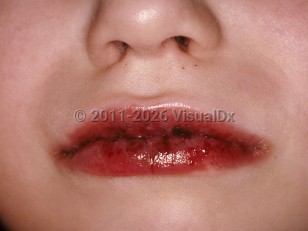
    Clinical image of Kawasaki disease - imageId=266240. Click to open in gallery.  caption: 'Erosions and hemorrhagic crusting on the lips.'
    Erosions and hemorrhagic crusting on the lips.
    Copyright © 2026 VisualDx®. All rights reserved.