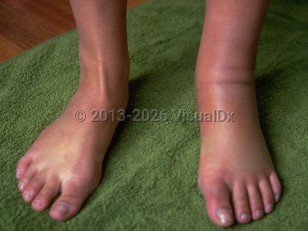
Loiasis (African eye worm) is caused by the filarial parasite Loa loa. The disease is endemic to Central and West Africa. The infection is transmitted to humans by the bite of blood-sucking flies of the genus Chrysops (deer fly, horse fly, mangrove fly). In endemic areas, increasing age and sustained exposure to forested environments are associated with a greater risk of acquiring the infection.
The clinical picture of loiasis differs between those individuals residing in endemic areas compared to visitors to these areas. In long-term residents of endemic areas, infection can be asymptomatic despite large numbers of microfilariae in the blood.
Because travelers to endemic regions are not immune to L loa, infection is characterized by localized subcutaneous swellings (Calabar swellings) and angioedema, both representing localized allergic reactions to L loa. These swellings are transient, lasting several hours to days, and most commonly occur on the extremities and face. Occasionally, migration of adult worms can be seen within or outside of the Calabar swellings as a moving wormlike structure. Pruritus or pricking sensations from adult worm migration is common in addition to arthralgia, fatigue, and myalgias. If the adult worm migrates under the conjunctiva (seen in 10%-20% of patients), a Calabar swelling can occur periorbitally, and this can be associated with eye pain.
Complications can include meningitis, encephalitis, nephropathy, endomyocardial fibrosis, and rarely, pulmonary involvement. Although loiasis is generally thought to be benign, these complications and an increased risk of mortality are more often seen in patients with high microfilariae levels and those living in endemic areas.
Loiasis
Alerts and Notices
Important News & Links
Synopsis

Codes
ICD10CM:
B74.3 – Loiasis
SNOMEDCT:
44250009 – Infection caused by Loa loa
B74.3 – Loiasis
SNOMEDCT:
44250009 – Infection caused by Loa loa
Look For
Subscription Required
Diagnostic Pearls
Subscription Required
Differential Diagnosis & Pitfalls

To perform a comparison, select diagnoses from the classic differential
Subscription Required
Best Tests
Subscription Required
Management Pearls
Subscription Required
Therapy
Subscription Required
References
Subscription Required
Last Reviewed:07/28/2026
Last Updated:07/29/2026
Last Updated:07/29/2026