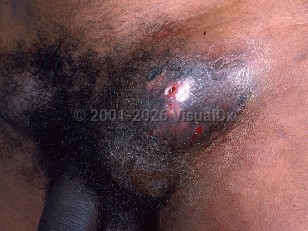
Lymphogranuloma venereum (LGV) is an uncommon sexually transmitted infection (STI) caused by the obligate intracellular bacteria Chlamydia trachomatis serovars L1, L2, and L3, with serovar L2b being the most commonly reported strain associated with the disease. Distribution is worldwide but most commonly seen in tropical and subtropical countries. LGV can present with genital ulcerative disease, lymphadenopathy, and/or proctocolitis. Infection can also be asymptomatic. Since 2023, LGV has also emerged in more developed countries, primarily in men who have sex with men (MSM), particularly those who practice condomless anal sex and have multiple partners. The L2b strain is predominant in this population, and in the pre-exposure prevention (PrEP) era, the majority of cases are identified in HIV-negative MSM PrEP users. Approximately one-half of cases identified in PrEP users diagnosed with LGV were asymptomatic. In the PrEP era, providers should consider the possibility of LGV infection in MSM patients regardless of HIV status or symptoms, particularly in those using PrEP.
In patients with HIV, LGV typically presents as proctitis but may be asymptomatic or exhibit atypical manifestations, which can complicate diagnosis and increase the risk of transmission.
There are 3 distinct stages in the course of the disease.
Stage 1:
After a 3- to 30-day incubation period, a small, painless papule or pustule develops on the genital area. Most often, it will erode and ulcerate. This lesion is often asymptomatic and heals without scarring within 1 week. Some patients may be unaware of this occurrence.
Stage 2:
The second stage occurs 2-6 weeks after the primary lesion and reflects the spread of the organism from the initial site to regional lymph nodes. When the primary lesion is located on the penis or at the urethra, the infection presents as inguinal buboes (painful inflammation of the inguinal lymph nodes), which become fluctuant and rupture. If the lesion is on the anus, it manifests as anorectal syndrome, with proctocolitis characterized by rectal discharge, anal pain, constipation, fever, and tenesmus. Patients may also experience systemic symptoms such as fatigue, headache, and weight loss. This is typically the stage when most patients seek medical attention.
Stage 3:
The third stage of LGV is elephantiasis of the penis and scrotum. This swelling is caused by fibrosis with occlusion of the lymphatics, which impedes lymphatic return. Genito-anorectal syndrome can also be seen in the third stage, but usually only in MSM or in women. These patients initially present with proctocolitis, followed by perirectal abscesses, strictures, fistulas, and rectal stenosis.
Lymphogranuloma venereum - Anogenital in
See also in: Overview,Cellulitis DDxAlerts and Notices
Important News & Links
Synopsis

Codes
ICD10CM:
A55 – Chlamydial lymphogranuloma (venereum)
SNOMEDCT:
186946009 – Lymphogranuloma venereum
A55 – Chlamydial lymphogranuloma (venereum)
SNOMEDCT:
186946009 – Lymphogranuloma venereum
Look For
Subscription Required
Diagnostic Pearls
Subscription Required
Differential Diagnosis & Pitfalls

To perform a comparison, select diagnoses from the classic differential
Subscription Required
Best Tests
Subscription Required
Management Pearls
Subscription Required
Therapy
Subscription Required
References
Subscription Required
Last Reviewed:04/29/2026
Last Updated:05/19/2026
Last Updated:05/19/2026
 Patient Information for Lymphogranuloma venereum - Anogenital in
Premium Feature
VisualDx Patient Handouts
Available in the Elite package
- Improve treatment compliance
- Reduce after-hours questions
- Increase patient engagement and satisfaction
- Written in clear, easy-to-understand language. No confusing jargon.
- Available in English and Spanish
- Print out or email directly to your patient
Upgrade Today
Lymphogranuloma venereum - Anogenital in
See also in: Overview,Cellulitis DDx