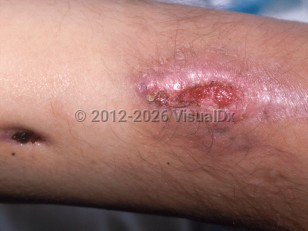
Nocardia spp are soil-dwelling, ubiquitous, gram-positive, filamentous, branching bacteria. The most common manifestation of nocardiosis is the pulmonary form, which typically affects patients with structural lung disease who have a malignancy or who are immunosuppressed.
Cutaneous nocardiosis is a rare bacterial infection of the skin and soft tissues caused by species of Nocardia. Nocardia brasiliensis is the most common cause of primary cutaneous disease, although other species, including Nocardia cyriacigeorgica, Nocardia farcinica, and members of the Nocardia asteroides complex, may also involve the skin.
Cutaneous nocardiosis may be primary (PCN), resulting from direct inoculation of the organism into the skin, or secondary, arising from hematogenous spread from another site of infection, most commonly the lungs.
PCN occurs after trauma to the skin and/or skin appendages, most often affects healthy patients, and accounts for up to 5% of all cases of nocardiosis. PCN affects males more frequently than females. Risk factors include soil or sand exposure, gardening, farming, superficial injury from domestic shrubbery, intra-articular steroid injections, insect bites, cat scratches, or trauma from motor vehicle accidents leading to abrasions (ie, "road rash"). Lesions may occur suddenly and rapidly progress, reactivate after several years of dormancy, or slowly expand over 10 years. Rarely, PCN can disseminate to other organs, but this typically occurs in the setting of significant immunocompromise.
Secondary cutaneous nocardiosis occurs in association with underlying systemic nocardiosis. Fistulae form from underlying infected tissues. Subcutaneous abscesses are another manifestation. In underlying pulmonary disease, lesions occur over the chest. They are more widespread in disseminated disease.
Cutaneous nocardiosis
Alerts and Notices
Important News & Links
Synopsis

Codes
ICD10CM:
A43.1 – Cutaneous nocardiosis
SNOMEDCT:
64650008 – Cutaneous nocardiosis
A43.1 – Cutaneous nocardiosis
SNOMEDCT:
64650008 – Cutaneous nocardiosis
Look For
Subscription Required
Diagnostic Pearls
Subscription Required
Differential Diagnosis & Pitfalls

To perform a comparison, select diagnoses from the classic differential
Subscription Required
Best Tests
Subscription Required
Management Pearls
Subscription Required
Therapy
Subscription Required
References
Subscription Required
Last Reviewed:04/19/2026
Last Updated:04/29/2026
Last Updated:04/29/2026
Cutaneous nocardiosis