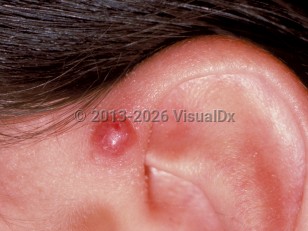
Angiolymphoid hyperplasia with eosinophilia (ALHE) is an uncommon, benign vascular proliferation typically seen in young to middle-aged adults with no sex predilection. ALHE is also referred to by other names, including epithelioid hemangioma, histiocytoid hemangioma, pseudopyogenic granuloma, inflammatory angiomatous nodules, inflammatory arteriovenous hemangioma, intravenous (IV) atypical vascular proliferation, and papular angioplasia.
ALHE typically presents with skin-colored, pink, dull red, or brown papules and/or nodules on the head and neck. ALHE most commonly occurs on the ears and periauricular areas, face, and scalp. Less common locations include the genitals (vulva or penis), trunk, and distal extremities. Most lesions are located dermally, but ALHE can involve the subcutis and deeper soft tissues. ALHE may also involve extracutaneous sites such as the bones, colon, parotid glands, mouth, and orbits. Peripheral eosinophilia may be present in a subset of patients. ALHE may present with pain, pruritus, and/or spontaneous bleeding, or it may be asymptomatic.
The underlying pathogenesis is unknown. There is no consensus as to whether the condition is reactive (possibly in response to trauma, infection, arteriovenous shunts, or hormonal imbalances) or neoplastic.
Of note, ALHE and Kimura disease, once thought to be disease variants, are now recognized to be separate, distinct diseases with specific clinical and histologic features.
Angiolymphoid hyperplasia with eosinophilia - Hair and Scalp
Alerts and Notices
Important News & Links
Synopsis

Codes
ICD10CM:
D18.01 – Hemangioma of skin and subcutaneous tissue
SNOMEDCT:
125574005 – Angiolymphoid hyperplasia with eosinophilia
D18.01 – Hemangioma of skin and subcutaneous tissue
SNOMEDCT:
125574005 – Angiolymphoid hyperplasia with eosinophilia
Look For
Subscription Required
Diagnostic Pearls
Subscription Required
Differential Diagnosis & Pitfalls

To perform a comparison, select diagnoses from the classic differential
Subscription Required
Best Tests
Subscription Required
Management Pearls
Subscription Required
Therapy
Subscription Required
References
Subscription Required
Last Reviewed:02/19/2026
Last Updated:02/19/2026
Last Updated:02/19/2026
Angiolymphoid hyperplasia with eosinophilia - Hair and Scalp