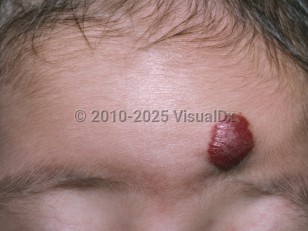
Infantile hemangioma in All Ages
See also in: External and Internal Eye,AnogenitalAlerts and Notices
Important News & Links
Synopsis

The most common benign tumors of infancy, occurring in up to 10% of infants, with up to 50% involving the head and neck. Precursors may be present at birth, evolving into a more classic appearance within the first few months of life. Usually, infantile hemangiomas grow rapidly during the first few weeks of life. This initial proliferative phase typically peaks as early as 2 months of age. This is followed by a steady state lasting months followed by gradual involution over several years, with more than 90% completely involuting by age 10. Although infantile hemangiomas involute with time, residual skin changes such as telangiectasia, scarring, atrophy, and fibrosis persist in up to 30% of lesions after involution is complete.
Codes
ICD10CM:
D18.01 – Hemangioma of skin and subcutaneous tissue
SNOMEDCT:
83343001 – Infantile hemangioma
D18.01 – Hemangioma of skin and subcutaneous tissue
SNOMEDCT:
83343001 – Infantile hemangioma
References
Subscription Required
Last Updated:10/19/2021
 Patient Information for Infantile hemangioma in All Ages
Premium Feature
VisualDx Patient Handouts
Available in the Elite package
- Improve treatment compliance
- Reduce after-hours questions
- Increase patient engagement and satisfaction
- Written in clear, easy-to-understand language. No confusing jargon.
- Available in English and Spanish
- Print out or email directly to your patient
Upgrade Today
Infantile hemangioma in All Ages
See also in: External and Internal Eye,Anogenital