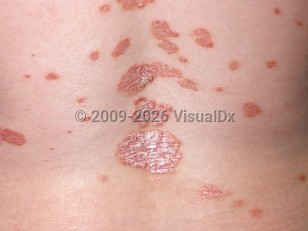
Psoriasis is a chronic, intermittently relapsing inflammatory disease characterized by sharply demarcated erythematous, silvery, scaly plaques. Psoriasis affects about 2% of the world's population and can develop at any age and in any sex. Psoriasis incidence has a bimodal pattern, with one peak in childhood and a second peak in adulthood.
Psoriasis is a polygenic disease, and several psoriasis susceptibility genes have been identified over recent years. Certain individuals with genetic susceptibility develop a psoriatic phenotype after exposure to environmental triggers such as infection, medications, and medical comorbidities, among others. Aberrant T-cell function and keratinocyte responses are believed to be major culprits in the pathogenesis of psoriasis.
Psoriasis is fairly common in childhood but may occur in infancy (see infantile psoriasis). It occurs worldwide and is estimated to affect 1%-3% of the population, with 20% of cases presenting before age 20 years.
Several clinical patterns exist, and multiple forms may be observed in a single patient. Typical plaque-type psoriasis (psoriasis vulgaris) is discussed here; other forms include guttate psoriasis (commonly seen in children and adolescents, often following an upper respiratory tract infection, usually streptococcal pharyngitis); palmoplantar psoriasis; erythrodermic psoriasis; and pustular psoriasis. Inverse psoriasis occurs in intertriginous or flexural areas of the body, such as the axillae, groin, genitals, inframammary areas, face, and eyelids. Linear psoriasis is a rare variant that is characterized by the distribution of psoriatic lesions along the lines of Blaschko. The pathogenesis remains unclear, but it seems to be related to genetic mosaicism.
Pediatric psoriasis may present as well-demarcated erythematous plaques limited to one body area (eg, the face, nails, genitals, scalp, feet, or even a solitary fingertip). Fingernails are more often involved compared to toenails in children. In one study, nail pitting was mostly seen in fingernails, while toenails exhibited onycholysis and paronychia. A review of pediatric psoriasis found that scalp psoriasis was more common in female patients, while nail involvement was more common in male patients, suggesting a possible role of chronic incidental trauma in these locations.
Anogenital psoriasis is rather common and usually is comparable to psoriasis found elsewhere on the body. It can be isolated to the genitalia but is often part of a more generalized condition. In females, inverse psoriasis is found on the mons pubis, labia majora, perianal skin, and inguinal folds.
Psoriasis - Anogenital in
See also in: Overview,Hair and Scalp,Nail and Distal DigitAlerts and Notices
Important News & Links
Synopsis

Codes
ICD10CM:
L40.0 – Psoriasis vulgaris
SNOMEDCT:
9014002 – Psoriasis
L40.0 – Psoriasis vulgaris
SNOMEDCT:
9014002 – Psoriasis
Look For
Subscription Required
Diagnostic Pearls
Subscription Required
Differential Diagnosis & Pitfalls

To perform a comparison, select diagnoses from the classic differential
Subscription Required
Best Tests
Subscription Required
Management Pearls
Subscription Required
Therapy
Subscription Required
Drug Reaction Data
Subscription Required
References
Subscription Required
Last Reviewed:08/27/2025
Last Updated:08/27/2025
Last Updated:08/27/2025
 Patient Information for Psoriasis - Anogenital in
Premium Feature
VisualDx Patient Handouts
Available in the Elite package
- Improve treatment compliance
- Reduce after-hours questions
- Increase patient engagement and satisfaction
- Written in clear, easy-to-understand language. No confusing jargon.
- Available in English and Spanish
- Print out or email directly to your patient
Upgrade Today
Psoriasis - Anogenital in
See also in: Overview,Hair and Scalp,Nail and Distal Digit