
The etiology of the disease is multifactorial, involving genetic, epigenetic, and environmental factors. The most well-established genetic markers for PsA versus nonarthritic psoriasis are IL23R and HLA-B. Interestingly, HLA-C*06:02, while being the main marker for psoriasis, is less often present in PsA. When this allele is found in PsA, it portends a milder arthritis regarding both time course and severity of symptoms. Epigenetic factors, which can be influenced by lifestyle and environmental factors, are also associated with onset of disease. Finally, continual stress and/or trauma (wear and tear) to joints and entheses may stimulate the psoriatic inflammatory cascade that has been well delineated over the last couple of decades, giving rise to the signs and symptoms of PsA.
PsA affects men and women equally and, similarly to psoriasis, it is predominantly seen in White individuals.
Symptoms:
- Pain and stiffness in affected joints, with joint stiffness present for over 30 minutes in the morning (after waking) or after prolonged inactivity. Improves with activity (versus osteoarthritis / degenerative joint disease, which typically worsens with activity).
- With axial involvement – Inflammatory back pain and stiffness that improve with activity; night symptoms can cause waking from sleep; decreased range of motion of the axial spine and neck over time.
- Tender / painful; swelling at entheses (sites of tendon insertion into bone).
- Tendonitis / tenosynovitis.
- Ocular inflammation may lead to scleral erythema, dry eye / foreign body sensation, or uveitis with potential visual disturbance and pain.
- Hearing loss is increased in patients with PsA.
- Tender, painful, swollen joints with possible erythema, effusion, and warmth noted in more actively inflamed joints.
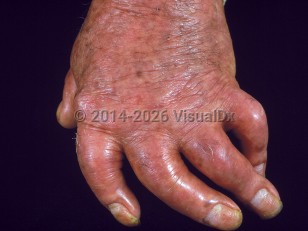
- Dactylitis – Inflammation and swelling of the entire digit including metacarpophalangeal (MCP) through proximal / distal interphalangeal (PIP / DIP) joints and intervening soft tissue, giving a "sausage digit" appearance.
- Enthesitis – Inflammation at tendinous insertion into bone, with tenderness.
- Distal (DIP) arthritis
- Oligoarthritis, asymmetric
- Rheumatoid arthritis (RA)-like symmetrical polyarthritis
- Arthritis mutilans – aggressive, destructive phenotype
- Axial spondylitis, sacroiliitis
Risk factors:
- Patients with nail, scalp, and inverse (intertriginous) psoriatic skin disease have a higher risk of developing PsA.
- Several genetic risk markers (HLA associations) are associated with development and variable prognosis in PsA.
- Progression to PsA among patients with psoriasis has been reported to occur at a rate of around 2% per year.
- Episodic flares of the disease in addition to chronic, baseline joint inflammation.
- Joint erosion / damage may accrue over time, with the potential for development of functional impairments.

 Patient Information for