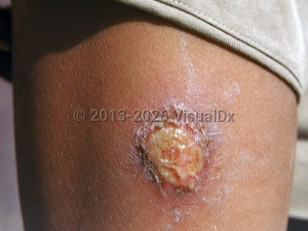

Clinical features can be categorized into early (primary and secondary), latent, and late (tertiary) stages.
- Primary yaws – After an incubation period of around 3 weeks (range 9-90 days), a small, painless papule appears that rapidly enlarges to a size of around 2-5 cm. Termed the mother yaw, or frambesioma, this primary lesion is teeming with spirochetes, is very pruritic, and is extremely infectious. The mother yaw may persist for 3-6 months before spontaneous resolution (sometimes with scarring or hypopigmentation). During the primary stage, the organism disseminates hematogenously and via the lymphatic system to give rise to secondary yaws weeks to months later.
- Secondary yaws – In this stage, scaly or moist papules, plaques, and nodules in localized, intertriginous, or generalized distributions occur. Oral mucous patches may be seen. This may be accompanied by fever, malaise, and generalized nonsuppurative lymphadenitis. Osteitis, periostitis, and dactylitis may also be seen at this stage. The cutaneous lesions last for weeks to months and resolve completely or with residual hypo- or hyperpigmentation.
- Latent yaws – Refers to individuals who have positive serological evidence of infection but do not exhibit any clinical manifestations.
- Tertiary yaws – Ten percent of individuals develop late-stage yaws after a latent period of 5-10 years. Recurrent self-healing skin and oral lesions may occur during this latent period. Late-stage yaws is marked by chronic skin ulcers (gummas) and painful, destructive bony changes.